There is a corner of the Adriatic where time seems to move at its own unhurried pace, where medieval towers rise above turquoise water, where vineyards spill down toward hidden coves, and where the only sounds are birdsong and the gentle lapping of waves against old stone. This is the world of the Korčula islands Croatia — a luminous cluster of islands in southern Dalmatia that has captivated sailors, poets, and wanderers for millennia.
The Korčula islands are not a single destination but an archipelago — a family of islands, islets, and rocky outcrops scattered across the Pelješac Channel and the broader Neretva Channel. At the heart of this group stands Korčula Island itself, the sixth largest island in all of Croatia, crowned by one of the most perfectly preserved medieval towns in Europe. Around it drift smaller islands, each with its own personality: Badija with its Franciscan monastery and free-roaming deer; Vrnik with its ancient marble quarries; Majsan with its wild olive groves; and Proizd, a tiny jewel of an island whose waters have been called among the clearest anywhere in the Mediterranean.
Together, the Korčula islands represent something increasingly rare in modern travel: a destination of extraordinary beauty, deep history, and authentic culture that has not yet been swallowed by mass tourism. They are, in a word, unmissable — and this guide is your invitation.
Overview of the Korčula Islands: An Archipelago in Southern Dalmatia
The term “Korčula islands” refers collectively to Korčula Island and the smaller islands and islets that surround it in the waters of southern Dalmatia. Geographically, this group sits in a strategically compelling position: the islands are sheltered from the open Adriatic by the Pelješac Peninsula to the north, which creates the calm, protected waters of the Pelješac Channel — conditions that make the area a paradise for swimmers, kayakers, and sailors.
The main islands and islets of the Korčula islands group include:
- Korčula Island — the anchor of the archipelago, stretching roughly 47 kilometres in length
- Badija — the largest of the smaller islands, famous for its monastery and deer
- Vrnik — a tiny inhabited island known for its extraordinary limestone
- Majsan — a wild, uninhabited island of ancient olive trees
- Proizd — a small, flat islet celebrated for its extraordinary transparent waters
- Gubešnica — a small islet near Vela Luka
- Sutvara, Prnova, and others — a scatter of smaller, mostly uninhabited rocky islets
The islands lie between approximately 42°50’ and 43°10’ north latitude, placing them in the warmth of the central-southern Dalmatian climate zone. Summers are long, hot, and dry; winters are mild and relatively wet. The Pelješac Channel separating Korčula Island from the Pelješac Peninsula is particularly narrow at one point — just under three kilometres wide at the crossing between the town of Orebić on the peninsula and Korčula Town on the island. This short stretch of water has been one of the busiest maritime crossings in the Adriatic for centuries.
The Korčula islands sit within the broader Dubrovnik-Neretva County, administratively connecting them to the historic capital of the Dalmatian coast, Dubrovnik, which lies roughly 85 kilometres to the southeast by road.
Korčula Island — The Queen of the Archipelago
Size, Geography, and Character
Korčula Island is the undisputed centre of the Korčula islands world. With an area of approximately 279 square kilometres, it is the sixth largest island in Croatia and one of the most densely forested, earning it the ancient Venetian name Corcyra Nigra — the Black Corfu — in reference to its dark pine forests. The island stretches roughly east to west, and its spine of low hills, reaching a maximum elevation of about 568 metres at Klupca, shelters numerous sheltered bays and coves along its southern and northern shores.
The island feels like a world unto itself. Olive groves, vineyards, stone villages, and pine forests alternate along its length. The population is concentrated in three main settlements — Korčula Town in the east, Vela Luka in the west, and the agricultural village of Blato in the interior — with dozens of smaller villages scattered between them.
Korčula Old Town — A Medieval Masterpiece

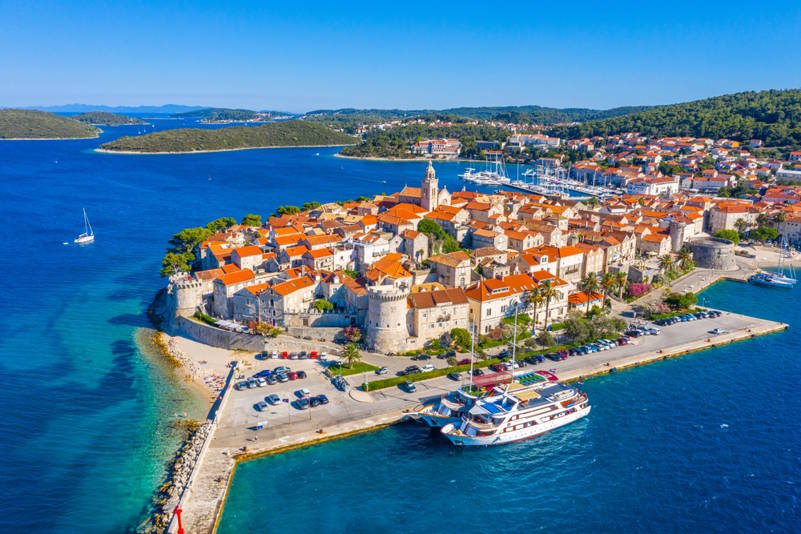
Korčula Old Town is the undisputed highlight of any visit to the Korčula islands. Built on a small peninsula that juts into the Pelješac Channel, the town is encircled by medieval walls, towers, and gates that have survived remarkably intact since their construction in the thirteenth and fourteenth centuries.
Walking through the Land Gate — the main entrance to the old town, framed by the imposing Revelin Tower — is a genuinely transporting experience. The streets inside follow a distinctive herringbone pattern, a medieval urban planning masterstroke designed to channel sea breezes and minimize exposure to storms. The main street, the Korčulanska ulica, is flanked by Venetian Gothic palaces, Renaissance loggias, and small churches. At the very tip of the peninsula stands the Cathedral of Saint Mark, a fifteenth-century masterpiece that contains paintings attributed to Tintoretto.
Korčula Old Town is also associated, at least by local tradition, with the birthplace of Marco Polo — the thirteenth-century Venetian explorer whose journeys to China captured the imagination of the medieval world. Whether or not the claim is fully historically verified, it adds a layer of romance and intrigue to an already extraordinary place. A house designated as Marco Polo’s birthplace stands near the cathedral and is open to visitors.
The Moreška Sword Dance is perhaps the most dramatic expression of Korčula’s cultural heritage. Performed every Thursday evening during summer (and nightly in July and August), the Moreška is a theatrical sword dance depicting a battle between two kings — the Black King and the White King — over a kidnapped princess. The performers wear elaborate costumes of red and black, and the choreography, which involves real steel swords clashing in rhythm, is genuinely thrilling. The Moreška has been performed continuously for more than four hundred years and is regarded as one of the most important examples of intangible cultural heritage in Croatia.
Villages: Lumbarda, Vela Luka, and Blato
Lumbarda, located about six kilometres southeast of Korčula Town along the island’s eastern tip, is one of the few places in Dalmatia where sandy beaches exist. The village has a relaxed, slightly bohemian character and is famous above all for the Grk grape — an ancient white wine variety grown only here, on the specific sandy soils that the Lumbarda plain provides. The village’s two main sandy beaches, Vela Przina and Pržina, are beloved by families and swimmers seeking an alternative to the rocky coves that dominate the Croatian coast.
Vela Luka, at the western end of Korčula Island, is the largest settlement on the island in terms of population and stretches along a long, sheltered bay that is one of the finest natural harbours in the Adriatic. The town has a working, lived-in quality that distinguishes it from more tourist-oriented settlements — it is a place where locals go about their daily lives, where fishing boats share the quay with pleasure craft, and where the evening passeggiata along the waterfront feels entirely authentic. Vela Luka is the departure point for day trips to Proizd Island, the most famous of the smaller Korčula islands, and it hosts the Cultural Centre which contains artworks by Henry Moore and Ivan Meštrović.
Blato, roughly midway along the island’s interior, is a traditional agricultural village whose character has been shaped more by farming, olive cultivation, and winemaking than by tourism. It has a gentle, unhurried quality and is particularly beautiful in spring when the almond trees bloom along the Aleja, a long promenade of ancient cypress trees at the edge of the village. Blato celebrates the Kumpanjija, another traditional sword dance, making it one of several Korčula settlements that have preserved this unique cultural heritage.
Wine: Pošip and Grk
The vineyards of Korčula Island produce two white wines of genuine distinction — wines that belong to the same company as Burgundy’s finest whites or Alsace’s grand crus in terms of their ability to express a unique place.
Pošip is arguably Croatia’s finest white wine grape. It is grown across much of Korčula Island, particularly around the village of Čara, where the rocky limestone soils and the particular microclimate of the island’s interior produce wines of remarkable freshness, complexity, and longevity. A well-made Pošip is full-bodied yet lively, with aromas of white peach, almonds, Mediterranean herbs, and a distinctive mineral quality that speaks of the sea. To sit in the shade of a fig tree on Korčula Island with a glass of chilled Pošip and a plate of fresh fish is to understand why people fall in love with this part of the world.
Grk is even more unusual. It grows only in Lumbarda, on the sandy soils of the Lumbarda Polje, and nowhere else on earth. The name “Grk” is thought to derive from the Greek settlers who may have introduced the vine to the island in antiquity. The wine itself is powerful, aromatic, and distinctively oxidative in character — not a wine for the timid, but for those who seek it out, an unforgettable expression of a specific place. Grk wine tastings in Lumbarda, often held in the producers’ own cellars, are among the most memorable experiences the Korčula islands can offer.
Getting Around Korčula Island
Korčula Island is served by a reasonable local bus network connecting Korčula Town, Blato, and Vela Luka. However, for true freedom of exploration, renting a car or scooter on the island is highly recommended. A car allows you to reach the hidden coves, the wine villages, and the quieter beaches that are inaccessible by public transport. Bicycles are also available to rent and suit those who prefer a slower pace — though the island’s interior hills make some routes genuinely challenging.
Badija Island — Deer, Monks, and Crystal Water

Just a five-minute water taxi ride from Korčula Old Town lies one of the most charming islands in the entire Korčula islands group: Badija. At roughly one square kilometre in area, it is the largest of the smaller islands near Korčula Town, and its combination of historical significance, natural beauty, and remarkable wildlife makes it utterly distinctive.
The island is dominated by a fourteenth-century Franciscan monastery, built in 1392 and continuously inhabited by monks until the twentieth century. The monastery complex — a low, honey-coloured stone building arranged around a peaceful cloister — is one of the best-preserved examples of medieval ecclesiastical architecture in the Adriatic. Today it functions partly as a sports centre and accommodation facility, but the Gothic cloister, the church, and the atmosphere of contemplative quiet that the monks left behind remain palpable.
What makes Badija Island Korčula truly unforgettable, however, is its population of free-roaming deer. The island has been home to a herd of fallow deer since their introduction in the twentieth century, and the animals wander freely through the pine forests, appearing at the edges of paths and clearings with remarkable nonchalance. Encountering a group of deer in the dappled light of a Dalmatian pine forest, with the sound of the sea audible on all sides, is one of those travel experiences that lodges permanently in the memory.
The beaches on Badija — a series of pebbly coves with remarkably clear, shallow water — are perfect for swimming. The island also has a designated naturist beach for those seeking complete seclusion. Because Badija is so easily and quickly reached from Korčula Town (water taxis operate throughout the day in summer), it makes an ideal half-day or full-day excursion — though those who want to fully appreciate its atmosphere are advised to arrive early and stay late, when the day-trippers have gone and the island returns to its quiet, unhurried self.
Vrnik Island — The Marble Island
Among the smaller islands near Korčula, Vrnik is perhaps the most historically fascinating. This tiny, inhabited island — just a few hundred metres across, home to a handful of permanent residents — conceals a remarkable secret: its limestone was among the most prized building material in the medieval and early modern Mediterranean.
The quarries on Vrnik Island Korčula produced a beautiful, dense, pale limestone that was used to construct some of the finest buildings in the region. The marble-like stone from Vrnik was used extensively in the construction of Dubrovnik — its palaces, churches, fountains, and streets all bear Vrnik stone. More remarkably, the same stone was shipped across the Atlantic: it was used in the construction of parts of the White House in Washington, D.C., making Vrnik one of those extraordinary places whose influence extends far beyond what its tiny size would suggest.
The quarrying tradition on Vrnik dates back at least to Roman times, and the marks of centuries of stonecutting are visible in the landscape — hollowed terraces, abandoned tools, and the beautiful pale-grey colour of the rock face. Today the island is quiet and largely overlooked by mainstream tourism, which makes it a particularly rewarding destination for curious travellers. A small fishing village of stone houses, narrow alleys, and old fig trees sits at the island’s centre, and the views back across the water to Korčula Town are lovely.
Vrnik is reached by water taxi or small boat from Korčula Town, and it makes a natural complement to a visit to Badija — the two islands are close together and can be combined into a single day trip without difficulty.
Majsan Island — The Olive Island
Further west along the Pelješac Channel, between the harbours of Korčula Island and the Pelješac Peninsula, lies Majsan — a small, uninhabited island of haunting, windswept beauty. Majsan is wilder and less visited than Badija or Vrnik, and its appeal lies precisely in that wildness.
The island is covered in ancient olive trees, some of which are believed to be hundreds of years old, their twisted silver trunks creating an almost otherworldly landscape. Olive cultivation on these small Dalmatian islands goes back to antiquity, and the archaeological record on Majsan confirms human presence stretching across millennia. The island contains the remains of a Roman settlement and an early Christian basilica, remnants of a community that once thrived here before the island was abandoned.
Today Majsan is accessible only by boat, and its lack of facilities — no restaurants, no facilities of any kind, just the trees, the ruins, the birds, and the sea — makes it best suited to those who are comfortable with a more self-sufficient form of exploration. Boat trips to Majsan can be arranged from Korčula Town and Vela Luka, and the island is sometimes included in wider excursions around the southern Korčula islands. For the right kind of traveller, an afternoon anchored off Majsan with a picnic, a swim, and no agenda is about as close to paradise as this part of the world gets.
Proizd Island — The Jewel of the Korčula Islands
If there is one island in the Korčula islands group that travellers come back from speaking of in hushed, reverent tones, it is Proizd. This small, flat, rocky island lies about five kilometres west of Vela Luka, and it has acquired a reputation — entirely justified — as one of the most beautiful small islands in all of Croatia.
The source of Proizd’s fame is its water. The sea around the island is exceptionally clear — not merely “clear” in the way that the sea everywhere in Croatia is clear, but clear in a way that seems to defy belief. On a sunny day, the water around Proizd Island Croatia displays a spectrum of blues and greens of extraordinary intensity: turquoise in the shallows, deepening through aquamarine and cobalt to a rich, deep blue in the deeper water. The sea floor is visible to depths that seem impossible, every rock and weed and passing fish perfectly legible through the water above.
The island itself is largely flat, covered in pine trees and low scrub, and encircled by a series of rock platforms and small beaches that provide perfect access to the sea. The snorkelling around Proizd is outstanding — the combination of clear water and a rich marine environment means that the underwater world here is genuinely rewarding to explore. Divers also speak highly of the waters around the island.
Day trips to Proizd depart from Vela Luka every morning throughout the summer season. The journey takes approximately twenty minutes by boat. Because the island has no permanent inhabitants and only basic seasonal facilities (a small bar operates in summer), visitors should bring food, water, and sun protection. The lack of shade on parts of the island means that the midday sun can be fierce — mornings and late afternoons are the most comfortable times to visit. Despite its growing reputation, Proizd remains uncrowded by the standards of more mainstream Croatian beach destinations, and a day spent there — swimming, snorkelling, reading in the shade of a pine tree, and watching the light change on the water — is one of the finest days the Korčula islands can offer.
Beaches of the Korčula Islands
The beaches of the Korčula Islands Croatia range from rare sandy stretches to the pebbly coves and rock platforms that typify the Dalmatian coast. Each has its own character.
Vela Przina, Lumbarda
Vela Przina is one of the most celebrated beaches in the Korčula islands — and, more broadly, in all of Dalmatia — for the simple reason that it is sandy. Sand beaches are remarkably rare on the Croatian coast, which is dominated by limestone rock and pebble, and the sandy beaches of Lumbarda (which exist because of the unusual sandy soil deposited in this part of the island) are therefore genuinely treasured. Vela Przina is a long, gently shelving beach with warm, shallow water that makes it ideal for families and for those who prefer a sandy entry to the sea. In summer it can become busy, but its size means that it rarely feels truly overcrowded.
Pržina (Lumbarda)
The second of Lumbarda’s sandy beaches, Pržina (also called Bilin Žal), is smaller and somewhat wilder than Vela Przina, located on the southern side of the Lumbarda peninsula. It has a more secluded feel and is popular with those seeking slightly more seclusion than the main beach offers. The walk between the two beaches through the Lumbarda Polje, with vineyards on either side, is itself a pleasure.
Badija Main Beach
Proizd Beaches
The rock platforms and small coves of Proizd are, as described above, among the most remarkable swimming spots in the Korčula islands in croatia. The water quality here is in a class of its own, and the combination of clear water, colourful seabed, and warm summer temperatures makes Proizd’s “beaches” — really a series of accessible rock ledges rather than beaches in the conventional sense — deeply memorable.
Hidden Coves of Korčula Island
Away from the main settlements, Korčula Island’s coastline is dotted with small bays and hidden coves that reward those willing to explore. Among the most beautiful:
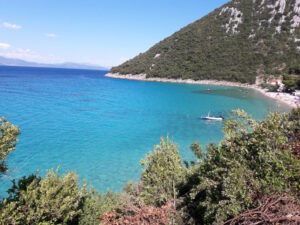
Pupnatska Luka is a secluded pebbly cove on the southern coast of the island, reached by a narrow road through vineyards and olive groves. The bay is surrounded by hills, the water is a rich turquoise, and the sense of seclusion is almost complete.
Brna is a long, narrow bay on the southern coast, sheltered and calm, with a small village at its head and good swimming on both sides of the inlet.
Zavalatica is a quiet bay with a small seasonal restaurant and excellent snorkelling amid the rocky underwater terrain.
Things to Do Across the Korčula Islands
Visit Korčula Old Town

Exploring Korčula Old Town is the starting point for any visit to the Korčula islands. Allow at least half a day — a full day if you want to include the Cathedral, the Marco Polo House, the Moreška, and a leisurely lunch. The Town Museum, housed in the fifteenth-century Gabrielis Palace, offers an excellent overview of the island’s long history.
Watch the Moreška Sword Dance
Wine Tasting: Pošip and Grk
Several excellent wine producers on Korčula Island Croatia offer tastings. In the village of Čara, Pošip producers welcome visitors to their cellars for guided tastings. In Lumbarda, Grk producers offer a unique window into one of the world’s rarest wine varieties. Many produce their own olive oil as well, making a wine and oil tasting one of the most authentically Dalmatian experiences available in the Korčula islands.
Kayaking Between Islands
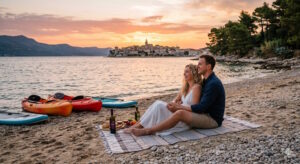
The sheltered waters of the Pelješac Channel and the proximity of Korčula Town to Badija and Vrnik make the Korčula islands an excellent area for sea kayaking. Multiple operators offer guided kayak tours departing from Korčula Town, ranging from half-day paddles to multi-day island-hopping expeditions. The relatively calm conditions in the channel (especially in the morning, before the afternoon winds pick up) make it accessible to beginners as well as experienced paddlers.
Snorkelling and Diving
The clear waters around the Korčula islands reward snorkellers and divers handsomely. The area around Proizd Island is particularly celebrated for snorkelling. For diving, several dive centres operate on the island and offer guided dives to underwater walls, caves, and wrecks in the surrounding waters.
Cycling Korčula Island
The island has a network of marked cycling routes ranging from easy coastal rides to more demanding inland routes that climb through vineyards and forest. The ride from Korčula Town to Lumbarda along the southern coast is one of the most beautiful and relatively straightforward cycling routes. For more adventurous riders, the central ridge of the island offers panoramic views and a real sense of the island’s wild, forested interior.
Boat Trips to Smaller Islands
Korčula Islands Food and Wine
The cuisine of the Korčula islands is firmly rooted in the Dalmatian tradition: simple, ingredient-led, deeply connected to the sea and the land, and profoundly satisfying.
Local Dishes
- Black risotto (crni rižot) — made with cuttlefish and its ink — is the defining dish of the Dalmatian coast and one of the great pleasures of eating in the Korčula islands. The best versions are made with freshly caught cuttlefish and a proper fish stock, and the result is a dish of deep savouriness and extraordinary colour.
- Fresh fish, simply grilled over charcoal with olive oil, lemon, and a scattering of chopped parsley, needs no embellishment. The waters around the Korčula islands yield dentex, sea bream, sea bass, and a variety of shellfish, all of which appear on restaurant menus in the freshest possible condition.
- Lamb from the Pelješac Peninsula and the island’s own herds, slow-roasted under the traditional peka (a cast-iron dome covered in embers), is another classic. The result — tender, fragrant with rosemary and herbs, suffused with the flavour of wood smoke — is one of the great dishes of the region.
- Makaruni is a pasta dish unique to Korčula — thick, hand-rolled macaroni served with a lamb meat sauce that has been cooked slowly with spices. It is a dish of considerable antiquity, possibly with Venetian or even earlier origins, and eating it in Korčula is to participate in a culinary tradition that stretches back centuries.
- Rozata is the Dalmatian answer to crème caramel — a set custard flavoured with rose water and caramelised sugar, served cold. It appears on menus throughout the Korčula islands and is the perfect ending to a meal.
Pošip Wine
Pošip wine deserves special mention. Croatia’s finest white wine grape, Pošip is grown across Korčula Island and produces wines of remarkable quality. The best examples from producers in Čara and surrounding villages are full-bodied yet fresh, with flavours of stone fruit, almonds, and herbs, underpinned by a mineral quality that reflects the island’s limestone soils. Korčula wine Pošip is increasingly exported and winning international recognition, but the place to truly understand it is on the island itself, ideally paired with fresh fish.
Grk Wine
Grk, as noted above, is grown only in Lumbarda and is a wine of real character — intense, oxidative, and unmistakably itself. It is not a wine for everyone, but those who appreciate it will find it one of the most distinctive and memorable white wines in the Mediterranean.
Olive Oil Korčula Island Croatia
The olive oil produced on Korčula Island Croatia is among the finest in Croatia — cold-pressed from olives grown on the rocky hillsides, it is grassy, peppery, and deeply flavourful. Many producers sell directly from their properties, and bringing home a bottle of Korčula olive oil is one of the most rewarding souvenirs possible.
Konoba Dining Culture
The konoba — a traditional Dalmatian tavern, typically family-run, with stone walls, wooden furniture, and a short menu of seasonal dishes — is the dining institution of the Korčula islands. Avoid the tourist-facing restaurants on the main squares and seek out the konobas in the villages and back streets. The experience of eating a long, unhurried lunch in a konoba, with local wine, good bread, and food cooked with genuine care, is one of the defining pleasures of a visit to the Korčula islands.
How to Get to the Korčula Islands
Getting to the Korčula islands involves a combination of road and sea travel — which is part of the pleasure. Croatia’s Adriatic coast is served by an excellent ferry network operated primarily by Jadrolinija, the state ferry company.
Ferry from Split
The most common approach from the north is the ferry from Split, Croatia’s second largest city and a major transport hub. Jadrolinija operates regular car ferry services from Split to Vela Luka (on the western end of Korčula Island) and to Korčula Town (via Hvar). The journey to Vela Luka takes approximately three hours, while the route via Hvar to Korčula Town takes somewhat longer. In summer, services run several times daily and it is strongly advisable to book vehicle spaces in advance.
Catamaran from Split and Dubrovnik
High-speed catamarans connect Split with Korčula Town (via Hvar and Lastovo) during the summer season. The journey is faster than the car ferry (approximately two to three hours from Split) but passengers cannot travel with vehicles. Dubrovnik is also connected to Korčula Town by catamaran during summer, making it possible to travel between the two without any road journey.
Ferry from Orebić — The Fastest Option

For those driving from Dubrovnik, the fastest and most convenient approach to Korčula Island Croatia is via the Pelješac Peninsula. The Pelješac Bridge, which opened in 2022, now connects the Pelješac Peninsula directly to the Croatian mainland — dramatically improving road access and eliminating the previously necessary transit through Bosnia-Herzegovina. From Dubrovnik, the drive along the Pelješac Peninsula to the town of Orebić takes approximately one hour and fifteen minutes along a coastal road of spectacular beauty.
From Orebić, a short 15-minute ferry crossing operates year-round between the Orebić harbour and Korčula Town. This is the simplest, most direct, and most romantically satisfying way to arrive in Korčula — standing on the ferry deck as the medieval walls of Korčula Town grow larger across the water is an arrival that sets the tone perfectly for everything that follows. The ferry runs frequently throughout the day and no advance booking is required for foot passengers; car spaces should be reserved in peak season.
Getting Around the Korčula Islands
Car and Scooter Rental on Korčula Island
For exploring Korčula Island in depth, hiring a car or scooter is the most practical option. Several rental agencies operate in both Korčula Town and Vela Luka. A small car allows access to the hidden bays, wine villages, and coastal roads that are inaccessible by bus. The island’s roads are generally well-maintained, though some routes to remote coves involve narrow, unpaved tracks.
Water Taxis Between Islands
Korčula Town is the hub for water taxi services to the smaller Korčula islands. Regular water taxis serve Badija (about five minutes) and Vrnik (about fifteen minutes) throughout the summer season, departing from the town quay. Services are frequent enough that no prior booking is usually required for the main routes.
Boat Tours and Excursions
For reaching more remote islands such as Proizd (from Vela Luka) and Majsan, organised boat excursions are the standard approach. These typically depart in the morning, spend several hours at the destination island, and return in the afternoon. Boats can also be privately chartered for those seeking more flexibility.
Cycling
As described above, cycling is an excellent way to explore the eastern part of Korčula Island — particularly the routes from Korčula Town to Lumbarda and around the island’s eastern tip. Bicycles can be rented from several shops near Korčula Town harbour. The western part of the island, with its more hilly terrain, is more suited to experienced cyclists.
Best Time to Visit the Korčula Islands
Spring (April to June): Quiet, Green, and Ideal
Summer (July and August): Vibrant but Busy
Summer is the peak season in the Korčula islands, and it shows. July and August bring the full intensity of the Dalmatian summer: hot, dry, brilliantly sunny days, and warm evenings alive with music, dining, and the particular energy of a busy tourist season. The Moreška is performed every evening. Korčula Old Town is at its most animated. The beaches and water taxis are busy. Accommodation prices are at their highest. Those who enjoy the buzz of a lively resort season will love the Korčula islands in summer; those who prefer tranquility may find July and August somewhat overwhelming.
Autumn (September and October): Arguably the Best Season
Many seasoned travellers argue that September and October are the finest months to visit the Korčula islands. The sea retains the warmth of summer — typically around 24-25°C in September — making swimming as pleasurable as in August. The crowds have thinned, prices have dropped, and the island takes on a more local, unhurried character. The grape harvest is underway in the vineyards, adding a particularly atmospheric and evocative layer to the experience. The light in autumn is softer and more golden than in the bleached intensity of summer, and the sunsets are spectacular. Restaurants are still open and have returned to their normal, non-overwhelmed pace. Autumn in the Korčula islands is, in many ways, the perfect combination of all the elements that make this place extraordinary.
Winter (November to March): Quiet and Atmospheric
Day Trip vs. Multi-Day Stay
What You Can See in One Day
If time is genuinely limited, a day trip to Korčula from Dubrovnik or Split is possible — and much better than not visiting at all. In a single day, the most rewarding combination is:
- Morning ferry from Orebić to Korčula Town
- Morning exploring Korčula Old Town (cathedral, Marco Polo House, walls)
- Lunch in a konoba in the old town
- Afternoon water taxi to Badija (swimming, monastery, deer)
- Return to Korčula Town for the evening Moreška (Thursday evenings in season)
- Evening ferry back to Orebić
This is a full and thoroughly rewarding day — though it will inevitably leave you wishing for more time.
Why 3 to 5 Days Is Better
Three to five days in the Korčula islands allows a genuinely thorough exploration. A suggested itinerary:
- Day 1: Arrive in Korčula Town, settle in, evening walk around the old town.
- Day 2: Full day exploring Korčula Old Town plus water taxis to Badija and Vrnik.
- Day 3: Drive or cycle to Lumbarda — sandy beaches and Grk wine tasting — and to Pupnatska Luka for a swim.
- Day 4: Drive to Vela Luka — explore the town and the Cultural Centre — then take the morning boat to Proizd for a full day of swimming and snorkelling.
- Day 5: Wine tasting in Čara, exploring the inland villages, final evening in Korčula Town for the Moreška.
This itinerary covers the highlights of the Korčula islands while maintaining a relaxed, Mediterranean pace. Add another day or two for more time in Blato, further exploration of hidden coves, or a return visit to a favourite beach.
Practical Travel Tips for the Korčula Islands
Ferry Schedules and Booking
The ferry network in Croatia is efficient and reliable, but in peak summer season (July and August), car spaces on ferries fill up quickly. Book your car ferry space well in advance — particularly for the Split to Vela Luka route and the Orebić to Korčula crossing. Passenger tickets do not need to be booked in advance on most routes. Check current schedules on the Jadrolinija website, as these change seasonally.
Car Rental
Cash and ATMs
Korčula Island has ATMs in Korčula Town, Vela Luka, and Blato. The smaller islands (Badija, Vrnik, Proizd) have no banking facilities, so ensure you have sufficient cash before departing for a day trip. Croatia uses the Euro (€) as its currency, having adopted it in January 2023.
Language
The local language is Croatian. However, English is widely spoken throughout the tourist industry in the Korčula islands, and most restaurants, hotels, and tour operators communicate easily in English. Learning a few words of Croatian — “Hvala” (thank you), “Molim” (please), “Dobar dan” (good day) — is always appreciated.
Tipping
Tipping is not obligatory in Croatia but is appreciated and increasingly common in tourist areas. A tip of around 10% for good restaurant service is considered generous and appropriate.
Sun Protection
The Dalmatian summer sun is intense, and the reflective quality of the sea and white limestone amplifies its effect. Sunscreen, a hat, and UV-protective clothing are essential for full days on the beaches and boats of the Korčula islands. The midday sun (roughly 12:00–16:00) is particularly fierce; plan swimming and beach time for mornings and late afternoons.
Navigation Apps
Google Maps works well throughout the Korčula islands and is the most reliable navigation tool. Maps.me (which can be used offline) is useful as a backup. For ferry times, the Jadrolinija app provides current schedules. The Windy app is useful for sailors and kayakers to check wind and sea conditions.
A Final Word on the Korčula Islands
There is a phrase that recurs in every conversation about the Korčula islands: posebno — a Croatian word that means “special”, but carries a weight and warmth that the English translation cannot fully convey. It is the word locals reach for when trying to explain what their islands mean to them. It is the word that returning visitors reach for when trying to explain why they keep coming back.
The Korčula islands are posebno for reasons that resist easy articulation. Perhaps it is the quality of the light on the Pelješac Channel in the late afternoon. Perhaps it is the taste of Pošip wine drunk at the source, in the shade of a vine, with the smell of the sea on the breeze. Perhaps it is the sound of steel sword blades clashing in the Moreška’s ancient choreography, watched in the lamp-lit streets of an eight-hundred-year-old walled town. Perhaps it is simply the feeling — rare and increasingly precious in a world of over-tourism and Instagram clichés — of having found somewhere genuinely, unhurriedly, authentically itself.
Whatever the reason, the Korčula islands have a way of claiming the people who visit them. They come for a week and return for a decade. They come for the beaches and stay for the wine. They come for Korčula Old Town and discover Lumbarda, Vela Luka, Badija, Vrnik, Proizd — each one a revelation, each one an argument for staying a little longer.
Go. Explore the Korčula islands at your own pace. Let the water taxi take you to Badija on a Tuesday morning. Get happily lost in the lanes of Korčula Old Town. Drink Pošip at a konoba table under a pergola of grapevines. Take the boat to Proizd and slip into water of impossible clarity. And when the time comes to leave — as it always, eventually, does — you will understand, in the most visceral and uncomplicated way, why posebno is the only word that really fits.