There is a particular kind of stillness you find on certain Adriatic islands — the kind that sneaks up on you slowly, settles into your shoulders, and makes you forget that the rest of the world exists at all. Badija Island delivers that feeling from the moment the water taxi pulls away from Korčula Old Town and the ancient stone shoreline begins to grow. No cars. No noise. No rush. Just the scent of wild rosemary on the sea breeze, the creak of pine trees overhead, and — if you are lucky — the soft footsteps of a deer emerging from the forest edge to watch you pass.
Badija Island Croatia is one of those places that travel writers reach for superlatives and still fall short. At barely one square kilometre, it is small enough to explore in an afternoon, yet rich enough in history, wildlife, and natural beauty to fill a day entirely. It sits in the heart of the Korčula archipelago, so close to the walled city of Korčula that the crossing takes just a few minutes by water taxi, yet it feels separated from the modern world by something far greater than distance.
This guide covers everything you need to know to plan a perfect day trip — from the island’s fascinating Franciscan monastery history to its famous deer population, its beaches and swimming coves, and the simple pleasures of wandering its pine-shaded paths with nowhere particular to be.
Where Is Badija Island?
Badija Island Korčula sits within the sheltered waters of the southern Dalmatian coast, just off the eastern tip of the island of Korčula in the Dubrovnik-Neretva County of Croatia. It is part of the wider Korčula archipelago, a scattering of small islands and islets that dot the channel between Korčula and the Pelješac Peninsula.
The island covers approximately 0.98 square kilometres, making it the largest of the islets surrounding Korčula and one of the most accessible. Its terrain is a gentle mix of pine forest, Mediterranean scrubland, and rocky coastline, with a central clearing around the monastery complex that opens onto grassy meadows. The highest point barely rises above sea level in any dramatic sense — this is not a rugged island of cliffs and peaks but a low, forested retreat that embraces the sea on all sides.
The position is remarkably convenient for visitors to Korčula. The water taxi crossing from Korčula Old Town takes less than ten minutes, making Badija Island one of the easiest day trip from Korčula options available. You can see the island from the town walls, its dark forest canopy sitting low and quiet on the water, and on still mornings the sound of birdsong seems to carry across the channel.
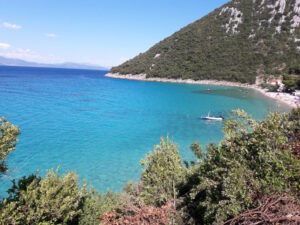
The surrounding waters are part of the same clear Adriatic system that defines southern Dalmatia — warm, shallow near the shores, and brilliant in a range of blues from pale turquoise to deep sapphire depending on the depth and the angle of the light.
Wildlife on Badija — The Famous Deer
If the monastery is Badija’s historical soul, the deer are its living spirit. The island is home to a free-roaming population of deer that wander its forest paths and meadows with an unhurried ease that feels almost deliberate — as if they know, on some animal level, that this small island is theirs.
How the Deer Came to Badija Island
The deer of Badija Island are commonly described in local tradition as roe deer, though the population today may include other cervid species as well. As mentioned in the island’s twentieth-century history, the animals are believed to have been introduced during the Yugoslav-era period when the island functioned as a recreation and sports facility. In the decades since that era ended, the deer have lived and bred freely, adapting entirely to island life.
The absence of predators and the island’s protected forested environment have allowed the population to establish itself comfortably. The deer have no reason to flee and, having lived alongside occasional human visitors for generations, they display a remarkable calm around people. Badija Island deer encounters are among the most memorable wildlife experiences the Croatian coast has to offer — not because of their rarity in absolute terms, but because of the intimacy they make possible.
What to Expect
Walking the forest paths of Badija, you will almost certainly encounter deer at some point during your visit. They tend to emerge most readily at the quieter hours — early morning before the day-trip crowd arrives, or in the late afternoon when the light turns golden and the island settles into its evening mood. But sightings happen at all times of day, and the animals may appear in the monastery grounds, along the beach paths, or standing calmly in the shaded forest interior with their large eyes watching you with mild curiosity.
The deer are wild animals. They are not tame, and they should not be fed or approached aggressively — but they are accustomed enough to human presence that close observation is entirely possible. Moving quietly, pausing when they appear, and allowing them to set the terms of the encounter will result in extended sightings that those who rush past will simply miss. Bring a camera with some zoom capacity and your patience.
Children, in particular, are enchanted by the Badija deer. There is something genuinely magical about a small Mediterranean island where deer walk freely among the pine trees and sometimes stand at the edge of the beach watching boats arrive.
How to get to Badija Island Croatia?
There are two simple and attractive ways – both available directly from Holiday Sun: Badija is just a few minutes away by taxi boat from Lučica or about half an hour by kayak.
- By taxi boat ⛴️
Several times a day, small taxi boats run directly to Badija from the port of Orebić. The ride takes about 10 minutes and offers a beautiful view of the Pelješac coast and the surrounding islands. Tickets can be purchased on site at an affordable price. - Kayaking 🛶
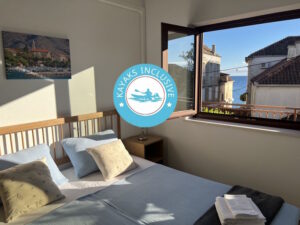
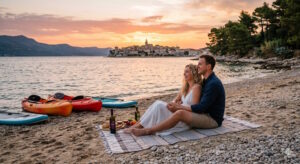
For those looking for adventure, we recommend kayaking from Holiday Sun! The distance to the island is about 2.5 km, and the route leads through the calm, turquoise sea. Our guests receive free kayaks directly from us – ideal for couples or solo explorers. Upon arrival at Badija, the kayak can easily be left by the shore, and you can explore the island at your own pace.
The History of Badija Island Croatia
The Franciscan Arrival
The history of Badija is inseparable from the history of the Franciscan monastery that dominates its interior, and that story begins in the fourteenth century. Franciscan friars arrived on the island in 1392, establishing a presence that would shape Badija’s identity for centuries. Their choice of location was deliberate — islands offered the kind of solitude and separation from worldly concerns that monastic communities prized, and Badija, with its sheltered coves and forested interior, provided exactly that kind of contemplative retreat.
The monastery complex that grew from that original settlement was substantially expanded during the fifteenth century, when the Franciscan monastery Badija reached something close to its current form. The church of Our Lady of Mercy, the cloisters, and the surrounding buildings were constructed and refined during this period, drawing on the characteristic stone masonry that defines ecclesiastical architecture throughout the Dalmatian islands.
The Venetian Period
For much of its early history, Badija Island existed within the orbit of Venetian power, as did the entire island of Korčula and the surrounding archipelago. Venice’s long dominance of the eastern Adriatic coast left its mark everywhere in this region — in the architecture, in the stone carving, in the urban patterns of towns like Korčula itself. The monastery on Badija was not untouched by these influences. The Franciscan community on the island lived through the full arc of Venetian rule, adapting to shifting political fortunes while maintaining the essential continuity of their religious life.
The friars remained on the island through centuries of change — through the gradual erosion of Venetian power, through the Napoleonic reorganisation of the region, and into the modern era. Their presence gave Badija a degree of continuity that most such small islands lacked.
The Twentieth Century and Yugoslav Era
The modern chapter of Badija’s story diverges sharply from its monastic origins. In the mid-twentieth century, during the Yugoslav period, the island was repurposed as a sports and recreation centre. The monastery complex was converted and adapted for use as a facility for athletes and workers seeking rest and recuperation. This was not an uncommon fate for religious properties in Yugoslavia — a country that maintained an ambivalent relationship with institutional religion. The friars departed, and for several decades Badija functioned in a thoroughly secular capacity.
It was also during this period, according to local accounts, that deer were introduced to the island. The animals — a small population of roe deer — were brought to Badija as part of the recreation facility’s character, adding a pastoral quality to the wooded grounds. The deer thrived in the island’s protected environment and eventually became one of its most distinctive features.
Badija Today
The Yugoslav-era sports centre eventually closed, and the monastery returned to a degree of quiet. Today, Badija Island exists in a state of contemplative semi-abandonment that gives it an unusual and rather beautiful atmosphere. The monastery complex stands — weathered, partially restored, still architecturally magnificent — and the island is open to day visitors who arrive by water taxi from Korčula. There are no permanent residents, no commercial establishments, and no infrastructure to speak of beyond the monastery and its grounds. This is precisely what makes Badija so remarkable.
What makes Badija Island special?
Badija is the largest islet in the Korčula archipelago, covered in pines, cypresses and Mediterranean vegetation. The island is famous for its 15th-century Franciscan monastery, which is located right on the coast. In addition to its cultural value, the island offers numerous walking trails, quiet beaches and crystal clear sea – ideal for swimming and relaxing.
But what makes Badija truly special are the fallow deer that roam freely around the island. These cuddly inhabitants of Badija happily approach visitors, hoping for a bite of a carrot or an apple. Children adore them, and adults cannot resist taking photos with them. The deer have become the island’s trademark and the reason why many guests return.
What awaits you on Badija?
- Untouched nature: The island is car-free, ideal for peaceful walks along the coast and an escape from everyday stress.
- Clear sea: Perfect for swimming, diving or sunbathing on the flat rocks.
- Cultural heritage: An impressive 15th-century Franciscan monastery bears witness to the region’s rich history.
- Wild animals: With a little luck, you will encounter tame deer that roam freely on the island.
Badija Island Monastery - Franciscan Cultural Heritage and Art
The Franciscan Monastery on Badija is not just a historical building – it occasionally hosts exhibitions and cultural events. Architecture lovers can enjoy the Gothic and Renaissance details, while the art gallery offers an insight into local creativity.
Badija Island Restaurant
The restaurant is a real hidden gem – with excellent food at very affordable prices. In my opinion, this is one of the best value for money in the Korčula area. The food is outstanding. For example, you can enjoy a perfectly cooked steak with homemade BBQ sauce.
The staff is friendly and helpful. The ambiance is picturesque. A great place for dinner and sunset by the sea.
Highly recommended for anyone spending their summer holidays on Pelješac or Korčula. The island is very peaceful and quiet.
Beaches and activities on Badija
The beaches on Badija are diverse – from pebbly and rocky areas to concrete terraces ideal for sunbathing. The island also has a bar with refreshments, public showers and toilets. For those looking for peace, Badija also offers secluded coves, perfect for escaping the crowds. Naturist lovers will also find their corner in the hidden parts of the island.
In addition to swimming and sunbathing, you can enjoy a walk around the island (approx. 4 km), meditate by the sea or simply observe the deer’s everyday life. For more active guests, there is also mini-golf, sports fields and the possibility of kayaking around the island.
Accommodation and recommendation
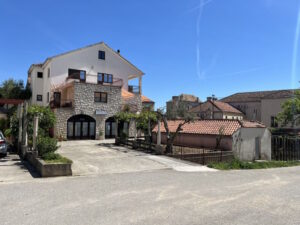
Although there is no traditional accommodation on Badija, the island is ideal for a day trip. Guests staying at VM Apartments Orebić can easily organize a trip to Badija – host Mišo will be happy to help with information about ferries, taxi boats and trip recommendations. With the apartments just 50 meters from the sea, Badija is the perfect complement to your vacation.
Conclusion

The island of Badija is a must-see destination for anyone vacationing on Pelješac or Korčula. The combination of nature, culture and deer magic makes it an ideal place to relax, take photos and create memories. Whether you are a couple looking for a romantic getaway or a family with children, Badija will win you over at first sight.