


















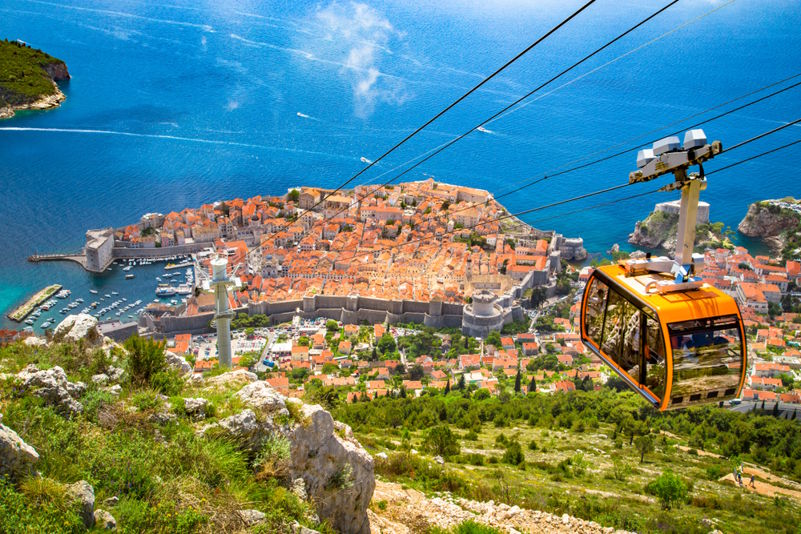
The picturesque Old Town of Dubrovnik, surrounded by impressive city walls, has been a UNESCO World Heritage Site since 1979. This historic gem boasts well-preserved medieval architecture and offers a wealth of cultural and historical sights waiting to be discovered.
Considered one of the best-preserved examples of medieval cities, Dubrovnik’s Old Town is now a living open-air museum.
Things to see in dubrovnik old town – Strolling through the narrow streets of the Old Town takes visitors to magnificent palaces, impressive churches and lively squares, all imbued with an aura of times gone by. Dubrovnik’s Old Town offers a unique combination of history, culture and breathtaking beauty.
To understand Dubrovnik, you must first understand what it once was: a free republic that survived for nearly five centuries through intelligence, diplomacy, and an almost stubborn insistence on independence. Founded in the seventh century by Roman refugees fleeing the Slavic invasion of Epidaurum — modern Cavtat, a few kilometres to the south — the settlement that would become Dubrovnik grew on a small rocky island separated from the mainland by a shallow channel.
That channel was eventually filled in during the twelfth century to form the Stradun, still the main artery of the old town today. But even before then, the city had begun its long rise under the name Ragusa — a name drawn, most likely, from the Latin word for the rocky promontory on which it stood.
The Republic of Ragusa survived the earthquake but could not survive Napoleon. In 1806, French forces occupied the city, and in 1808 the republic was formally dissolved — ending over four centuries of independence. Dubrovnik passed to the Habsburgs, then to Yugoslavia, and finally to the newly independent Croatia in 1991.
That year brought a horror the city had not seen in centuries. As the Yugoslav wars began, the Serb and Montenegrin forces of the Yugoslav People’s Army besieged Dubrovnik — a city with no military significance — for eight months, bombarding it with artillery in full view of the watching world. The shells damaged or destroyed roughly two-thirds of the buildings in the old town, shattered the medieval roof tiles, and killed hundreds of civilians.
The international community was outraged. UNESCO moved quickly to coordinate a reconstruction effort that became one of the largest and most meticulous in European history. Artisans were brought in to source and cut the same limestone from Korčula island that had been used for centuries. Roof tiles were matched to historical photographs. By the mid-1990s, Dubrovnik’s scars had been largely healed — though those who look carefully will notice the difference in shade between the old tiles and the new.
That the city not only survived but thrived is testament to the same stubborn vitality that kept the Republic of Ragusa independent for so long. Dubrovnik Old Town history is, at its heart, a story about a city that refused to disappear.
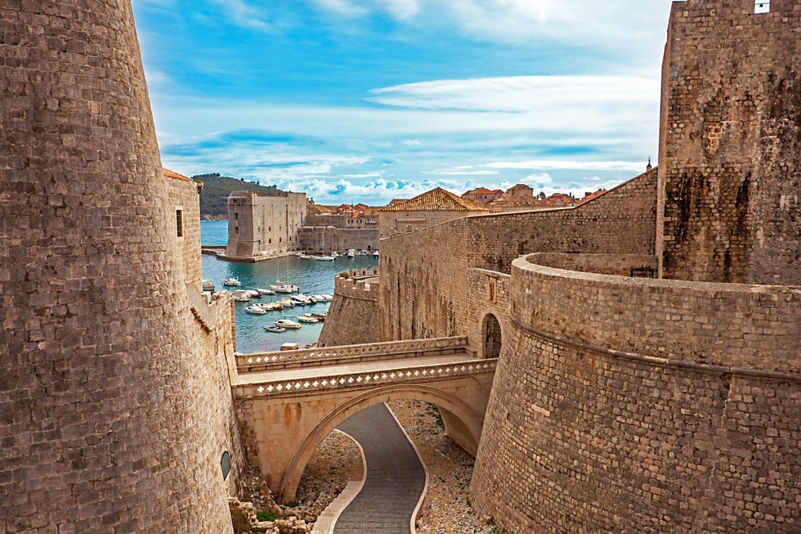
No visit to Dubrovnik Croatia is complete without walking the city walls — arguably the single most spectacular thing you can do in the entire country. Built between the eighth and sixteenth centuries and standing largely intact to this day, the walls encircle the entire old town in a continuous loop of roughly two kilometres, rising in places to a height of twenty-five metres and stretching to a width of six metres at their thickest point.
The views from the top are extraordinary. On one side: the old town spreads out below you, a tightly packed mosaic of orange rooftops, church domes, and narrow stone streets. On the other: the Adriatic, its improbable blue shifting with the light from turquoise to navy to the deepest green depending on the hour and the season. There is a reason this walk has been described by travel writers for decades as one of the finest urban walks in the world. The claim does not feel like an exaggeration when you are up there.
The wall, which is up to 25 metres high and six metres wide in some places, was built to defend the city against attacks from sea and land. It is a prime example of medieval military architecture and one of the best-preserved fortification systems in Europe.
Walking on the dubrovnik old town city walls is an unmissable experience for every visitor. dubrovnik old town walking tour, which lasts about 1.5 to 2 hours, offers stunning panoramic views of the Old Town, the azure sea and the surrounding landscapes. It is advisable to start the walk in the early morning or late afternoon to avoid the crowds and the heat of the day.

The Cathedral of Dubrovnik, also known as the Cathedral of the Assumption of the Blessed Virgin Mary, is a magnificent example of Baroque architectyour. Built in the late 17th century, after the devastating earthquake of 1667 that destroyed the original Romanesque church, the cathedral reflects the city’s reconstruction phase.
The facade of the cathedral is impressive, with its large pilasters, niches with statues, and a large central window that fills the interior of the church with natural light. The interior of the cathedral is equally impressive, with an ornate main altar and several side chapels, each decorated with ornate paintings and sculptures.
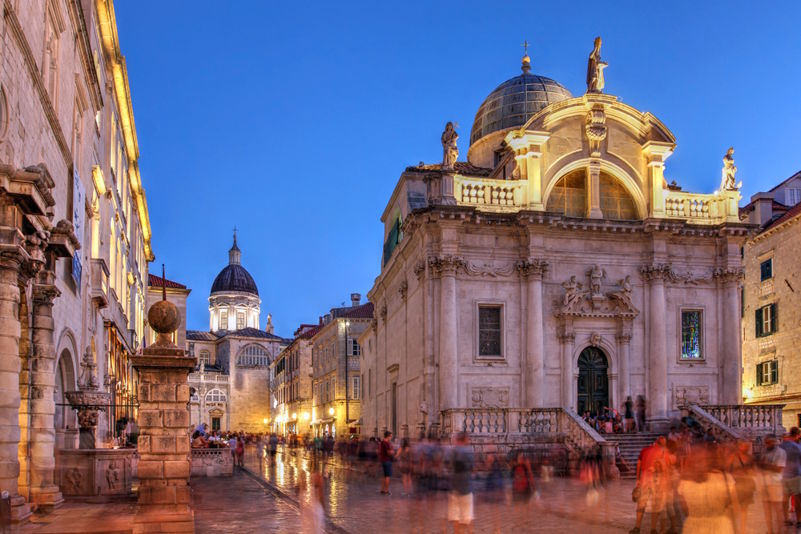
A particularly fascinating aspect of Dubrovnik Cathedral can be seen at night. As the sun sets and the city is bathed in a soft light, the cathedral’s great dome shines in all its glory.
The nighttime illumination highlights the architectural details of the cathedral and creates an almost mystical atmosphere. This nighttime scenery makes the cathedral a popular subject for photographers and a romantic attraction for evening strolls through the old town.
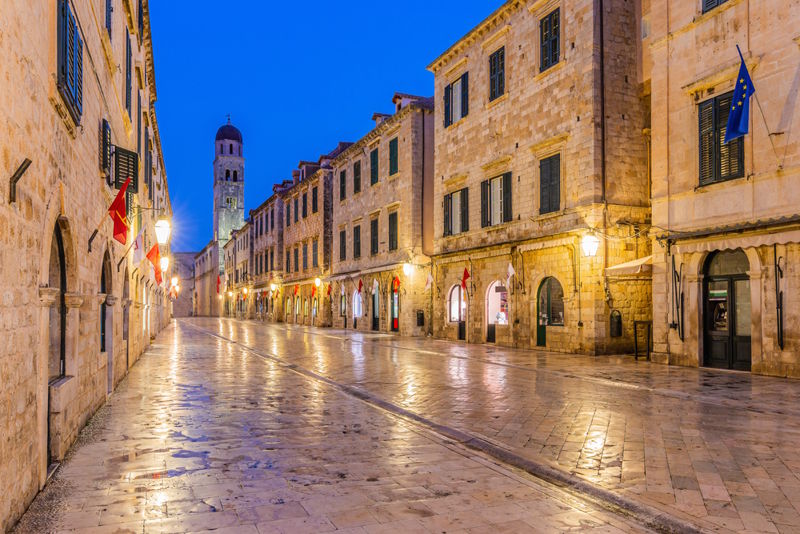
Stradun, also known as Placa, is the main central street of Dubrovnik Old Town. This impressive street stretches straight from west to east, connecting the Pile Gate in the west with the Ploče Gate in the east. The street is paved with smooth limestone slabs and is lined on both sides by symmetrical, uniformly designed stone houses built after the reconstruction.
The Stradun is about 300 meters long and was rebuilt in the Baroque style after a devastating earthquake in 1667 that destroyed large parts of Dubrovnik Old Town.
The Stradun is not only an architectural masterpiece, but also the beating heart of dubrovnik old town. The street is lined with numerous shops, boutiques and souvenir shops offering a variety of products, from handmade goods to high-end fashion items. This makes the Stradun a popular shopping destination for tourists and locals alike.
The atmosphere on Stradun is a mix of historic charm and vibrant urban life. A stroll along this street allows you to admire the well-preserved Baroque architecture while experiencing the hustle and bustle that makes this central axis of the Old Town so special.
In Dubrovnik Old Town there are two famous fountains that are considered masterpieces of medieval architecture: the Big Onofrio Fountain and the Small Onofrio Fountain.
The Great Onofrio Fountain, located at the western end of the Stradun near the Pile Gate, is particularly impressive. With its circular basin and central dome, it is a popular meeting place and a prominent landmark of the city. The fountain is decorated with 16 carved masks from which the water gushes, and served as the city’s main water supply in the Middle Ages.
The Small Onofrio Fountain is located at the eastern end of the Stradun, near the Ploče Gate and Sponza Palace. Although smaller and less elaborate than its large counterpart, it serves a similar function and is a charming sight.
Both fountains were designed and built in the 15th century by the Neapolitan architect Onofrio della Cava to supply the city with fresh water from a spring about 20 kilometers away. They are integral parts of Dubrovnik’s historic water supply system and testaments to the engineering skills of the time.
The Pile Gate and the Ploče Gate are the two main entrances to Dubrovnik’s Old Town and serve as important connecting routes for visitors and locals. The Pile Gate, located west of the Old Town, is the main entrance and an impressive example of medieval architecture. It consists of an outer and an inner gate, connected by a drawbridge that once crossed a moat.
The Ploče Gate, east of the Old Town, provides another important entrance and is similar in structure to the Pile Gate. Here too there is a combination of outer and inner gates, connected by a bridge.
Historically, both gates played a central role in the defense and control of the city. Both gates are decorated with magnificent statues and ornaments that reflect Dubrovnik’s rich history and cultural heritage.
Sponza Palace is one of the most magnificent buildings in Dubrovnik Old Town and an outstanding example of Dalmatian Renaissance architecture. Built in the early 16th century, it combines Gothic and Renaissance elements.
The palace originally served as a customs house and was a central point for trade in Dubrovnik. Merchants from all over the world came here to clear their goods and conduct business. In addition, Sponza Palace has been used for various purposes over the centuries, including as a mint, treasury and bank.
Nowadays, Sponza Palace houses the Dubrovnik State Archives, which houses valuable documents and historical writings. This collection includes important records dating back to the 12th century and provides an invaluable insight into the city’s history and cultural heritage.
In addition to its function as an archive, the Sponza Palace also serves as an exhibition venue for various cultural events and exhibitions. Visitors can view changing exhibitions here that cover both historical and contemporary topics.
The Franciscan Monastery in Dubrovnik is an impressive example of medieval architecture and an important cultural heritage of the city. The monastery was originally built in the 14th century, but was rebuilt and expanded several times due to wars and natural disasters. After a devastating earthquake in 1667, it was rebuilt in the Baroque style, preserving many Gothic and Romanesque elements.
A prominent feature of the Franciscan monastery is the picturesque courtyard, which is surrounded by about 120 finely crafted columns. Each of these columns is individually decorated and features elaborate reliefs depicting various plant and animal motifs.
The monastery church houses one of the oldest pharmacies in Europe, which has been in operation since 1317 and now serves as a museum.
The Franciscan monastery houses a museum that exhibits a valuable collection of sacred artworks, manuscripts and historical artifacts. Particularly noteworthy are the old medical equipment and recipes from the pharmacy, which offer a fascinating insight into the medical history of the Middle Ages.
When HBO chose Dubrovnik as the filming location for King’s Landing — the capital of the Seven Kingdoms in Game of Thrones — it set off a wave of cultural tourism that transformed the city’s international profile. For several years during filming (roughly 2011 to 2019), the old town was the backdrop for some of the most-watched television in history. Fans who arrive today find that the reality is, if anything, even more spectacular than the screen.
The overlap between the show’s fictional city and the real city of Dubrovnik is remarkably strong. The city walls, the harbour, and the narrow stone streets needed almost no modification to convince audiences they were watching a medieval fantasy capital. This is not a coincidence: the show’s creators specifically sought a location with the visual weight and historical authenticity that Dubrovnik uniquely possesses.
Dubrovnik is a true gem of the Adriatic, combining rich history and impressive architecture. For an unforgettable visit to Dubrovnik Old Town, we recommend starting the day early to avoid the crowds and enjoy the fresh morning air.
Start at the Pile Gate and take a walk on the city walls to enjoy the impressive views. Then, explore the main street, Stradun, and take a break in one of the many charming cafes.
Don’t miss the historic fountains of Onofrio and the Sponza Palace, which offers a fascinating insight into Dubrovnik’s past. A visit to the Franciscan monastery is also worthwhile, especially the quiet courtyard and the museum. Plan the evening so that you can see Dubrovnik Cathedral at night – the illuminated dome is a sight to behold.
Dubrovnik offers a perfect mix of history, culture and picturesque beauty that captivates every visitor, map of dubrovnik old town.
Ready for your next dream vacation?
At Holiday Sun rooms & more, you’ll find more than just an Orebić seaside accommodation – you’ll find an experience that will create lasting memories.
With us, you’re not just booking Orebić Rooms, you’re booking a complete ocean experience. Grab our complimentary kayaks or SUP boards and discover hidden coves right on our doorstep in Orebić.
🌊 Book your getaway in the sun now!
Ready to experience the charm of Orebić and the Pelješac Peninsula? Whether you are looking to spend your days relaxing just 50m from the beach, exploring hidden islands with our complimentary kayaks and SUP boards, or simply enjoying a glass of local wine in our quiet Mediterranean garden—our studios are the perfect sanctuary for couples and solo travelers.
Check availability directly or explore our studio rooms and free amenities and book directly.
Looking for beachfront apartments in Orebić for couples? Our studios are the ideal choice for a perfect Mediterranean vacation.