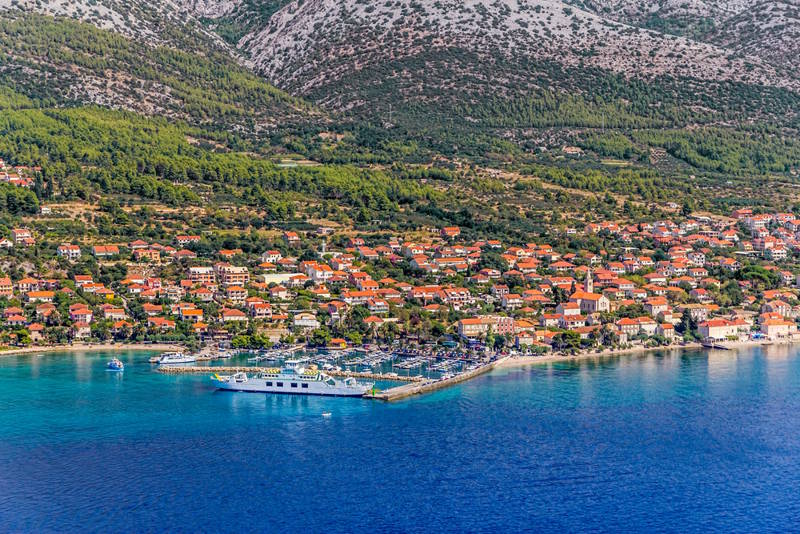
Orebić Croatia – There is a moment, somewhere between the ferry crossing and the first glimpse of the old stone waterfront, when Orebić stops being a destination on a map and starts feeling like something far more personal — like a place you have always half-remembered, even if you are arriving for the very first time.
The salt air reaches you before the town does. Then the silhouette of Korčula island appears across the narrow channel, close enough that you can count its church towers in the afternoon light. The Pelješac mountains rise behind you, steep and pine-dark, and the Adriatic glitters ahead in shades that shift from pale jade to deep sapphire depending on the hour and your mood. Somewhere along that coastline, a kayak is waiting.
This is Orebić, Croatia — and it is one of those rare places that rewards people who actually look for it.
This guide covers everything you need to know: how to get here, what to do, where to eat and drink, when to come, and where to stay so that the experience feels genuinely yours rather than borrowed from a brochure
Where Is Orebić? A Pelješac Peninsula Overview
Orebić sits at the southwestern tip of the Pelješac Peninsula, a long, narrow finger of land that stretches roughly 65 kilometres into the Adriatic from the Dalmatian mainland. Pelješac is connected to the rest of Croatia — and, since 2022, directly to Dubrovnik — by the Pelješac Bridge, an elegant 2.4-kilometre span that changed the geography of southern Dalmatia almost overnight. Before the bridge opened, reaching the peninsula required either a ferry crossing or a detour through Bosnia and Herzegovina. Now, Pelješac Croatia is accessible by road from Split in under two hours and from Dubrovnik in roughly an hour.
That bridge matters, because Pelješac was already extraordinary before it. The peninsula holds some of Croatia’s most celebrated wine country, its best oyster beds, a coastline that alternates between rocky coves and long pebble beaches, and a string of small towns where life still moves at the unhurried pace the Mediterranean once promised everywhere.
Orebić itself — population a little over four thousand — sits directly across a narrow strait from Korčula island, a UNESCO-adjacent medieval town often described as a smaller, quieter Dubrovnik. The proximity to Korčula is one of Orebić’s great gifts: you are moments from an island fortress town, yet you wake up in a place that has not been polished smooth by mass tourism.
Getting to Orebić, Croatia
By car from Split: Follow the A1 motorway south to Ploče, then take the coastal road (D8) through Ston and along the peninsula to Orebić — approximately 1 hour 45 minutes to 2 hours depending on traffic.
By car from Dubrovnik: Cross the Pelješac Bridge from the southern end and follow the D414 along the peninsula — approximately 1 hour to 1 hour 15 minutes.
By bus: Regular bus services connect Orebić to Dubrovnik and Split via the mainland. Journey times are similar to car travel but check schedules in advance, particularly outside summer.
By ferry from Korčula: If you are island-hopping, the passenger and car ferry between Korčula Town and Orebić runs frequently throughout the day (more on this below).
Top Things to Do in Orebić
Swimming and Beaches
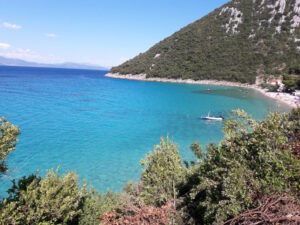
The beaches around Orebić range from organised pebble stretches near the town centre to wilder coves tucked beneath the hills that require a short walk or a paddle to reach. The water is famously clear — the Adriatic here is shallow enough near shore that you can see every stone on the sea floor, yet deep and cool enough to be genuinely refreshing even in August.
Prapratno Beach, a few kilometres east of town, is a favourite among local families and visitors who prefer a long, open stretch of pebble and shallow water. Trstenica Beach is closer to the town centre and tends to be livelier in summer, with cafés and shade. For something quieter, the coastline west of Orebić rewards exploration — small inlets accessible by foot or kayak that feel like your own private discovery.
Kayaking and Stand-Up Paddleboarding
The stretch of water between Orebić and Korčula is one of the most beautiful kayaking corridors on the Adriatic. The channel is calm enough for beginners in good weather, the views across to Korčula’s medieval walls are extraordinary, and the morning light on the water — before the summer boats arrive — is the kind of thing you find yourself trying to describe to people who were not there.
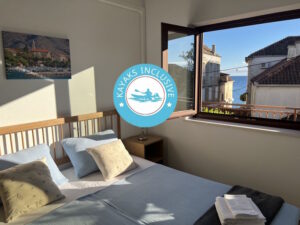
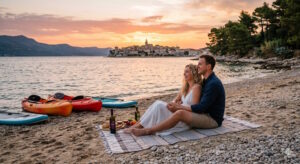
For guests staying at Holiday Sun rooms & more on Obala Pomoraca, kayaks and SUP boards are provided free of charge. The sea is fifty metres from the front door — eighty-six steps, to be precise. You carry your kayak down in the morning, paddle where you like, and return when you are hungry. It is a simple arrangement that turns out to be one of the best things about a stay in Orebić.
Stand-up paddleboarding works particularly well here in the early morning or evening, when the wind is down and the channel glasslike. First-timers find the conditions forgiving. People who have paddled before find them addictive.
Hiking the Pelješac Mountains
The hills directly behind Orebić are steep and fragrant with pine, sage, and Mediterranean scrub. The most rewarding hike in the area leads up to the Franciscan Monastery of Our Lady of the Angels, perched dramatically on the hillside above town. The monks who built it here in the fifteenth century clearly understood the view: Korčula island spread across the water below, the peninsula rolling west, the open Adriatic beyond.
The trail takes roughly forty minutes uphill from the town centre and is manageable for anyone in reasonable condition. The monastery itself is worth a visit inside — the collection of ex-votos left by sailors is quietly moving, a record of the sea’s moods across several centuries.
For more serious hikers, the spine of the Pelješac Peninsula offers longer trails into the interior, with views across to Hvar and the islands on clear days.
Orebić Town Centre and Local Life
Orebić does not try to be something it is not. The waterfront promenade — the Obala — is lined with old stone houses, a handful of café-bars, and boats tied up in the easy, permanent way of towns where people actually live. The Maritime Museum offers a compact but genuinely interesting account of the peninsula’s seafaring heritage: Orebić produced more captains per capita than almost anywhere else in the Adriatic during the age of sail, and the town’s handsome stone houses were built on the proceeds.
The weekly market, held in the town square, is worth arriving for: local vegetables, island cheese, olive oil, dried herbs, honey. These are the ingredients that will end up on your table at the BBQ that evening.
The Orebić to Korčula Ferry: Everything You Need to Know
The Orebić to Korčula ferry is one of the most frequently used and most scenically rewarding short crossings on the Croatian coast. The channel between Orebić and Korčula Town is approximately two kilometres wide, and the ferry crossing takes around fifteen minutes.
Jadrolinija, Croatia’s national ferry operator, runs the service throughout the year, with dramatically increased frequency in summer (typically every thirty to forty-five minutes during peak hours in July and August). Outside summer, crossings are less frequent — check the current timetable on the Jadrolinija website before planning your day trip.
The ferry carries both foot passengers and vehicles. If you plan to take a car to Korčula in high season, arrive early and expect queues — the crossing is popular and capacity is finite. Foot passengers board after cars and rarely wait long.
What to know:
- The Orebić ferry terminal is a short walk from the town centre, just off the main waterfront road
- Return tickets are inexpensive — this is one of the better-value experiences on the Dalmatian coast
- The crossing itself is part of the pleasure: the views of both shores are superb, and in good weather you will want to stand on deck for the full fifteen minutes
Korčula from Orebić: What to Do on the Island
Korčula Town is a medieval walled city that sits on its own small peninsula, its grid of streets laid out in a herringbone pattern specifically designed to channel sea breezes while blocking winter winds. The defensive walls, the Cathedral of Saint Mark, and the narrow lanes between tall stone houses give it an atmosphere that is genuinely mediaeval without feeling preserved in amber — people live here, children run through the lanes, washing hangs from windows.
Key things to do in Korčula from Orebić:
- Walk the full circuit of the old town walls
- Visit the alleged birthplace of Marco Polo (historians disagree, but the house is worth seeing)
- Watch the Moreška sword dance, performed regularly in summer — a dramatic piece of living tradition
- Eat grilled fish and drink Pošip wine at a konoba in the old town
- Explore the island by bicycle or rental scooter — the vineyards and beaches on the island’s southern shore are beautiful
Given the short ferry crossing, Korčula makes an ideal full-day excursion from Orebić, with plenty of time to explore the old town, have a long lunch, and return in the evening with the sunset behind you.
Pelješac Wine, Food, and the Ston Oysters
The Wine Region
Pelješac is Croatia’s most important red wine peninsula, and arguably one of the finest wine-producing landscapes in the entire Mediterranean. The Dingač appellation — carved into the south-facing slopes above the sea between Potomje and Lovište — produces wines from the Plavac Mali grape that are among Croatia’s most celebrated: deep, concentrated, and structured in a way that rewards patience but is also excellent with food right now.
A Pelješac wine tour does not require hiring a guide, though guides can add context. The wineries along the peninsula — including names like Miloš, Bartulović, and Matuško — welcome visitors for tastings, typically with advance notice. Driving the wine road through Potomje and down to the Dingač vineyards (the road passes through a tunnel carved through the mountain — an engineering project undertaken specifically to bring the wine down to sea level) is an experience in itself.
For white wine lovers: the nearby island of Korčula produces Pošip and Grk — crisp, aromatic whites that are the perfect match for the seafood you will be eating.
The Food
Dalmatian cuisine along the Pelješac Peninsula follows the honest logic of place: what is grown here, what is caught here, what has been made here for generations. The cooking is not complicated, but it is very good.
Grilled fish and shellfish are the foundation. Whole sea bream or sea bass, grilled over charcoal with olive oil and herbs, is a meal that is hard to improve upon. Local restaurants and konobas along the coast serve it simply, with local olive oil, capers, and a glass of whatever the family makes.
Lamb from Pelješac — the animals graze on the hillside herbs, which flavours the meat distinctively — is one of the peninsula’s great pleasures when it appears on a menu.
Peka is a slow-cooked dish (lamb or octopus, typically) prepared under a bell-shaped lid buried in embers. It requires advance ordering and a long wait, and it is absolutely worth both.
Ston and the Oysters
Twenty kilometres inland from Orebić — but worth the short drive — Ston is a fortified town famous for two things: the longest preserved defensive walls in Europe after the Great Wall of China, and oysters. The Mali Ston bay produces oysters that are eaten raw in quantities that suggest the locals consider them a basic food group. They are served in virtually every konoba in the area, usually with a glass of white wine and a wedge of lemon, and they are genuinely exceptional — the bay’s particular salinity and the way the tides move through it producing a flavour that is cleaner and more mineral than most. A day trip from Orebić to Ston takes less than half an hour by car and is something no visitor to the peninsula should miss.
Day Trips from Orebić
The location of Orebić makes it an unusually good base for exploring southern Dalmatia. Within a day’s reach:
Korčula Island
Already covered above — and worth re-emphasising as a day trip destination. Take the morning ferry, spend the day on the island, return in the evening.
Dubrovnik
The Pelješac Bridge brought Dubrovnik significantly closer to the peninsula. From Orebić, allow roughly one hour by car. Dubrovnik needs no introduction — the old city walls, the limestone streets, the view from the Srđ cable car — but it is worth arriving early to beat the cruise ship crowds that dominate from late morning in summer. Going in shoulder season (May, September, October) transforms the experience. From Orebić as a base, a Dubrovnik day trip is entirely manageable.
Ston
The short drive to Ston is justified both by the walls — walk them for panoramic views over the two bays — and the oyster lunch that should follow. If you have time, drive further along the Pelješac Peninsula toward Ston’s twin town, Mali Ston, where the oyster farms sit directly in the bay and the konobas open practically onto the water.
Mljet National Park
Mljet island — reachable by ferry from Prapratno, a few kilometres from Orebić — contains a national park with two saltwater lakes, a twelfth-century monastery on a small island within the larger lake, and a level of quiet that can feel almost shocking. A summer day on Mljet rewards the effort of getting there.
Best Time to Visit Orebić, Croatia
Summer (July–August)
The peak. The water is at its warmest, the days are long and reliably dry, and the Adriatic light in late afternoon is unlike anything in northern Europe. It is also the most crowded period, with prices highest and accommodation at a premium. If you are visiting in summer, book early — months in advance for the best places.
Shoulder Season: May–June and September–October
For most travellers, particularly couples and those who value something more than a beach holiday, May to June and September to October are the best months to visit. The sea is warm enough for swimming from late May, the crowds thin considerably, prices drop, and the peninsula returns to something closer to its everyday self. The light in September is extraordinary — warm and golden, without the bleaching intensity of July. The vineyards begin their harvest in late September, which adds another layer to a stay.
At Holiday Sun rooms & more, Mišo — the owner who manages the property directly — will tell you honestly that June and September are his favourite months. The town is present but not overwhelmed. The sea is ready. The restaurants are not frantic.
Low Season (November–April)
Orebić in winter is quiet in the way that places can be quiet when they are genuinely themselves rather than performing for visitors. Many restaurants and accommodation options close, and some of the ferry connections reduce. But for travellers who seek the off-season — who prefer their Dalmatia without a queue — winter on Pelješac has a particular atmosphere: the mountains dusted with snow against a blue sea, the konobas warm and unhurried, the wine good.
The low season rates at Holiday Sun rooms & more reflect this reality — a studio apartment for two people in November is among the best-value propositions in Dalmatia, in a location that does not require justifying.
Where to Stay in Orebić: Holiday Sun Rooms & More
Accommodation in Orebić ranges from large package-holiday hotels to private rooms and apartments. The right choice depends on what kind of trip you want — and what matters to you in a place to sleep.
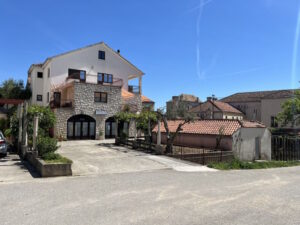
For couples travelling to Orebić who want to feel genuinely welcomed rather than merely processed, Holiday Sun rooms & more at Obala Pomoraca 20 represents something that is increasingly rare: an owner-operated boutique property where the person who greets you at the door is the same person who will give you the best restaurant recommendation of your trip.
The Studio Apartments
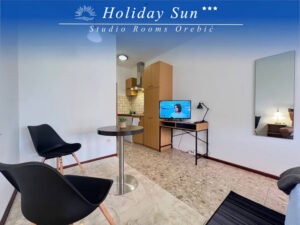
Holiday Sun has six studio apartments, each twenty square metres, each designed with the same clarity of purpose: a king-size bed (180 × 290 cm), air conditioning, a balcony, free Wi-Fi, satellite TV, and a secure private parking space. The rooms are not large, but they are right: everything in them is what you actually need, and nothing you do not. The balconies look toward the sea. The sea is fifty metres away — eighty-six steps from the front door, if you count them, and guests do.
“I always tell people: don’t spend money on a room with a better view. Spend it on the kayak morning. The kayak morning is what you’ll talk about.”— Mišo Kojić, host
The Extras That Change the Trip
Every guest at Holiday Sun receives complimentary use of kayaks and SUP boards — no rental fee, no booking form, no waiting. You take them when you want and return them when you are done. For a property fifty metres from the Adriatic, this is the right thing to offer, and Mišo understands it.
The BBQ area is available to guests throughout the stay. Pick up fish at the market in the morning, buy vegetables, bring local wine. The evenings here do not need to be expensive to be excellent.
Mišo also provides what might be the most underrated feature of any accommodation: genuine local knowledge. He knows which restaurant is actually worth the slightly longer walk, which beach is quieter on a Saturday afternoon, which winery will welcome you for a tasting without a reservation. This is the kind of information that takes years to accumulate and is entirely absent from any travel website.
Awards and Recognition
Holiday Sun rooms & more holds the Booking Traveller Review Award 2026 — an award based entirely on guest scores, which means it cannot be purchased or lobbied for. The property is also certified as a Local Host by the Croatian National Tourist Board (HTZ), a designation that recognises genuine commitment to authentic hospitality and knowledge of the local area.
Pricing
- High Season: €69 per night
- Shoulder Season: €59 per night
- Low Season: €49 per night
At these rates, for a property fifty metres from the Adriatic, with kayaks and SUP boards included, owner-operated and award-recognised, the value is evident.
Book direct at holiday-sun.com for direct communication with Mišo and the best availability.
Practical Travel Tips for Orebić, Croatia
Getting Around
Orebić town centre is walkable. The beaches, the ferry terminal, the restaurants, and the market are all within comfortable walking distance of the main waterfront. For day trips to Ston, Dubrovnik, or the Dingač vineyards, a car is the most practical option — though buses connect the peninsula to Dubrovnik and Split if you prefer not to drive. Bicycle and scooter rentals are available in town in summer.
Parking
Parking in Orebić is generally easier than in larger Croatian towns. The seafront road has public parking, and guests at Holiday Sun have access to secure private parking — a detail that saves a surprising amount of time and anxiety during peak season.
Language
Croatian is the official language, and outside the tourist centres, English proficiency varies. A few phrases of Croatian go a long way — locals genuinely appreciate the effort. The basics: Dobar dan (good afternoon), Hvala (thank you), Molim (please), Jedan bijeli/crni, molim (one white/red wine, please). Mišo at Holiday Sun speaks English and German fluently and is happy to translate when needed.
Currency and Payments
Croatia joined the Eurozone in January 2023, so the currency is the Euro (€). Cards are widely accepted in restaurants, shops, and accommodation, but it is worth carrying some cash for smaller markets, konobas in remote locations, and the ferry.
Internet and Connectivity
Mobile coverage on the Pelješac Peninsula is reliable in the main towns and on the coastal roads, though it can be patchy in the mountains. Holiday Sun provides free Wi-Fi throughout the property.
Medical and Practical
The nearest hospital is in Dubrovnik. For minor needs, there is a pharmacy in Orebić and a small health clinic. Travel insurance that covers medical costs is always recommended for Croatian coastal travel.
Best Restaurants in Orebić
Orebić’s dining scene is modest in size but high in quality relative to price. The best meals are often at family-run konobas where the menu is short and the fish was alive this morning. Mišo at Holiday Sun maintains a current list of recommendations and will match them to your preferences — whether you want a long, celebratory dinner or the best grilled fish in town for twelve euros.
Conclusion: Why Orebić Deserves Your Time
Orebić Croatia is not a place that markets itself aggressively. It does not need to. The Pelješac Peninsula has been producing extraordinary wine, exceptional seafood, and genuinely warm hospitality for centuries, and it has not forgotten how. The Pelješac Bridge has made it easier to reach without making it less worth reaching. The ferry to Korčula still takes fifteen minutes. The sea is still clear. The mornings are still quiet.
What Orebić offers is something that is harder to find than most travellers expect: an Adriatic destination where the experience belongs to you rather than the crowds, where the food tastes like it was made with intent, where the person who hands you the keys to your room is also the person who will tell you about the hidden cove three kilometres up the coast that does not appear on any map.
That person, at Holiday Sun rooms & more, is Mišo. The cove is worth knowing about.
Ready to experience Orebić for yourself? Holiday Sun rooms & more has six studio apartments, fifty metres from the Adriatic, with kayaks and SUP boards included, personal hospitality, and the kind of local knowledge that only comes from a lifetime on the peninsula.
Book direct at holiday-sun.com — and arrive somewhere that will feel, very quickly, like somewhere you have always half-remembered.
Holiday Sun rooms & more — Obala Pomoraca 20, Orebić, Pelješac Peninsula, Croatia. Booking Traveller Review Award 2026. HTZ Local Host certified.